If you plan to buy in the next few years, your down payment should sit somewhere safe, easy to reach and earning something while you save. That usually means an insured savings product, not the stock market. Money you need on a set timeline shouldn't depend on where markets happen to be the month you write an offer.
Here are the best places to keep down payment savings, what each one is good for and the paper-trail rules lenders apply when it's time to use the money. It's the same advice whether you're saving for a first home or moving cash around before you sell and buy.
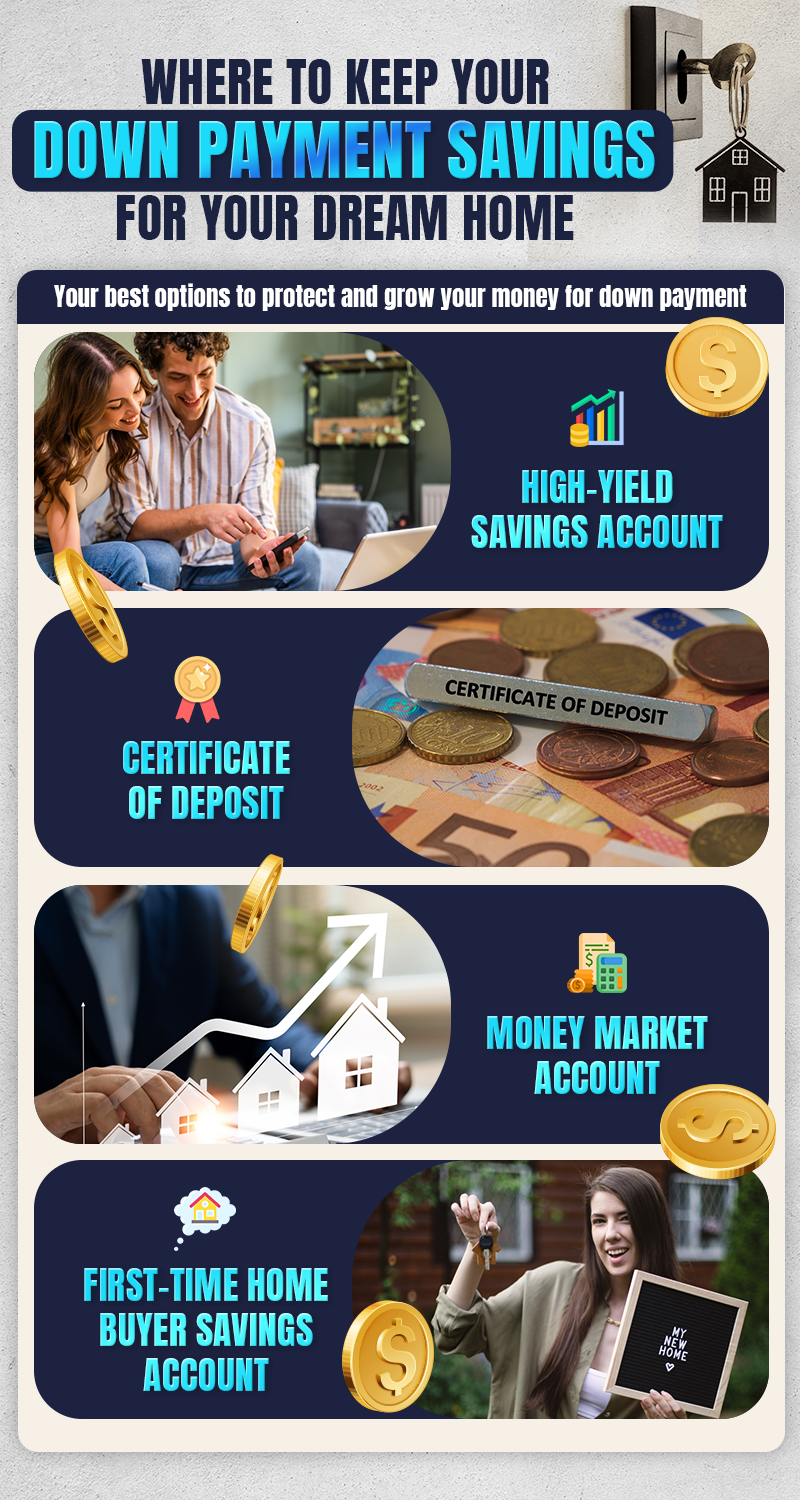
High-yield savings accounts
Best for: most buyers, especially if your timeline is uncertain.
A high-yield savings account works like a regular savings account but usually pays noticeably more interest, often through an online bank or credit union. You can move money in and out when you need to, and deposits at an FDIC-insured bank or NCUA-insured credit union are protected up to $250,000 per depositor, per institution, per ownership category.
The tradeoffs: the rate can change at any time, and some accounts have minimum balances or limit how many withdrawals you can make each month. Look for no monthly fees, a strong rate history and transfers that reach your checking account in a day or two.
Certificates of deposit (CDs)
Best for: savers with a firm buying date who want a locked rate.
A CD pays a fixed rate for a set term, such as six months or a year. You usually get a better rate for committing, but taking money out early typically costs you some of the interest. That's a problem if the right house shows up sooner than you planned.
One way around it is a CD ladder: split your savings across CDs that mature at different times, so part of your money becomes available every few months. Some banks also offer no-penalty CDs, which pay a bit less but let you withdraw without a fee after an initial period.
Money market accounts
Best for: buyers who want savings-account safety with a little more flexibility.
A money market account at a bank or credit union is insured like a savings account and often comes with check-writing or a debit card. Rates are usually competitive with high-yield savings, though some require a higher minimum balance to earn the best rate.
Don't confuse it with a money market fund, which you buy through a brokerage. A fund is generally low-risk and easy to sell, but it isn't FDIC-insured. Short-term Treasury bills are another low-risk option some buyers use. Either can work if you understand how and when you can get your cash.
First-time homebuyer savings accounts
Best for: buyers in states that offer them.
Some states let first-time buyers open a dedicated savings account and deduct contributions on their state income taxes, as long as the money goes toward buying a home within a set period. Each program has its own limits and rules, and using the money for something else can mean paying back the tax benefit.
California doesn't currently offer a state program like this. If you're buying here, look instead at down payment assistance from CalHFA and local programs, which can work alongside your savings. More on how down payment assistance works.
Make sure a lender can use the money
Where your money sits matters at closing as much as while you save. Lenders typically review your most recent two months of statements for every account you'll use, and they'll ask about deposits that aren't from your paycheck.
Move money early. Consolidate funds into the account you'll close from at least a couple of months before you apply, so the statements tell a simple story.
Avoid cash deposits. Cash is hard to document and may not be usable.
Document gifts. If family is helping, plan for a signed gift letter and a record of the transfer. See how down payment gifts work.
Plan any investment sales. If you're selling stocks or using retirement funds, talk with your lender about timing and documentation first. Volatile assets like crypto usually need to be sold and moved into a bank account well before closing.
Which should you choose?
If you might buy within a year or two, or you're not sure when, a high-yield savings account is the simplest choice. If you know roughly when you'll buy, a CD ladder can earn a little more without locking up everything at once. Most buyers end up using a mix: a savings account for flexibility and a few short CDs for the portion they won't need right away.
Whatever you choose, keep a separate cushion for emergencies so your down payment stays a down payment. And remember that your down payment is only part of the cash you'll need. Closing costs, moving and the first months in a new home all add up. Here's more on closing costs.
What to do next
Talk with a lender before you move money, so your savings plan matches how your loan will be underwritten. A fully reviewed pre-approval will also show you how much you need to save. When you're ready, search homes across the East Bay.
Want help planning your down payment? Call or text 925-876-0876, or reach us here.
Pacific Residential Partners | NMLS #633518 | DRE #02101650